
Enterprise teams don’t have a testing problem. They have a test design problem. This guide challenges the conventional approach to test automation moving the conversation away from tools and speed, toward understanding, risk, and meaningful coverage. The future of quality engineering begins here.
Most organisations follow a predictable path. A new application is implemented, business analysts document requirements, testers create manual test scripts, and as delivery accelerates, leadership pushes for automation. Automation engineers are then asked to automate the existing manual test suite. At first glance, this seems entirely logical. The problem is that nobody has questioned whether the manual test suite represents the right coverage in the first place.
Over time, organisations accumulate thousands of test cases that duplicate effort, validate low-risk functionality, miss critical business scenarios, fail to reflect changing business processes, and prioritise volume over value. The automation team successfully automates these tests. Coverage metrics improve. Dashboards look impressive. Yet critical production defects still occur with troubling regularity.
The reason is straightforward. Automation has improved execution efficiency, but it has not improved testing effectiveness. These are fundamentally different outcomes and conflating them is one of the costliest mistakes in enterprise quality engineering.
Many organisations measure quality using metrics such as number of test cases, percentage automation coverage, and tests executed per release. These metrics are not inherently wrong but they create a profound and dangerous false sense of confidence when they are treated as proxies for actual quality. A suite containing 5,000 automated tests may still fail to validate the scenarios that matter most to the business.
The Metric Trap
Organisations that optimise for coverage percentage and test count often find themselves with impressive dashboards and disappointing production stability. The numbers look right. The outcomes do not.
Real-World Examples
Consider these scenarios, which are more common than most organisations would like to admit:
The issue is not execution. The issue is coverage. More specifically, meaningful coverage the kind that maps directly to business risk, operational impact, and the scenarios that cause real harm when they fail in production. Until organisations make this distinction, automation investment will continue to underdeliver.
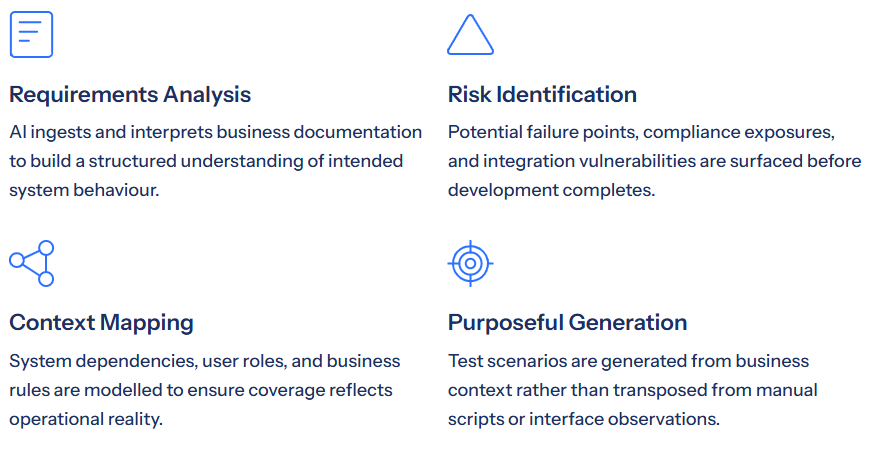
Contextual AI Testing is an approach that uses artificial intelligence to understand the context behind software before creating tests. Traditional automation tools focus on what users click. Contextual AI focuses on why the system exists. This is not a subtle distinction it represents a fundamental reorientation of how quality engineering organisations should think about their work.
Rather than treating tests as a reflection of existing scripts or manual procedures, Contextual AI builds a model of the business: its processes, its rules, its risks, and its dependencies. It analyses business requirements, user stories, acceptance criteria, process documentation, policies and procedures, configuration data, platform behaviour, historical defects, integration dependencies, and user roles and permissions. This rich contextual understanding becomes the foundation for all test design decisions.
The goal is not to generate more tests. The goal is to generate the right tests. This changes everything from how QA teams engage with stakeholders, to how test suites are maintained, to how organisations measure and report on quality. Contextual AI does not replace human expertise it amplifies it, surfacing coverage gaps and risk areas that would take experienced testers weeks to identify manually.
To understand the practical difference Contextual AI makes, consider an employee onboarding process running through ServiceNow. A traditional testing approach may validate employee record creation, manager approval, account provisioning, and completion notifications. These tests confirm the workflow functions as designed which sounds reassuring until you recognise that business processes rarely operate under perfect conditions.
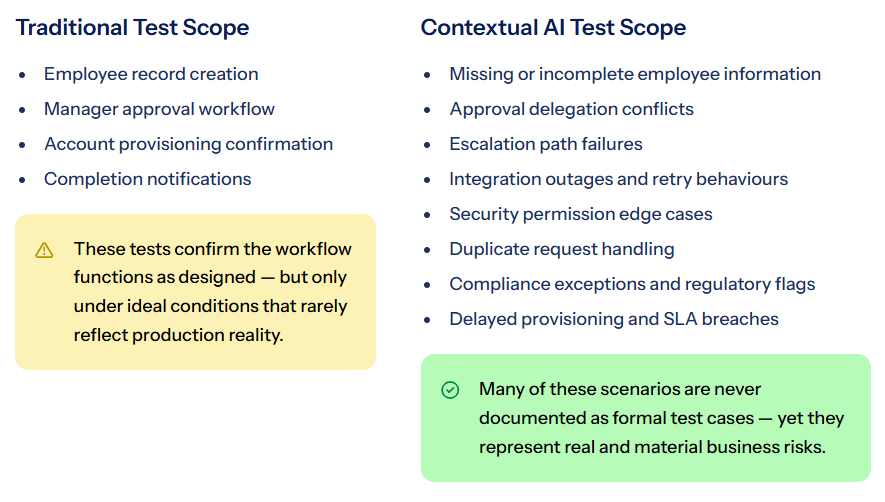
By understanding the process context, AI generates test conditions that humans frequently overlook not because human testers lack skill, but because the cognitive effort required to anticipate every exception path across a complex enterprise system is simply beyond what any team can consistently sustain at scale. Contextual AI makes comprehensive coverage achievable and repeatable.
Most organisations approach test automation backwards. They begin by asking how to automate tests faster, when the real question should be whether they have the right tests in the first place. Many testing programs are built on incomplete requirements, outdated test cases, and assumptions about how users interact with systems. As a result, organisations often automate thousands of test scenarios while still missing the business-critical workflows and risks that matter most.
Modern AI-driven testing addresses this challenge by shifting the focus from test execution to test design. Rather than simply automating existing scripts, Contextual AI analyses business processes, requirements, user stories, integrations, and risk areas to determine what should be tested before automation begins. This ensures testing is aligned to business outcomes, not just application functionality.
The most effective quality engineering programs now follow a five-stage approach. First, they develop a deep understanding of the business processes being supported. Second, they analyse requirements and identify gaps, ambiguities, and hidden risks. Third, they generate comprehensive, risk-based test scenarios that cover both expected outcomes and potential failures. Fourth, they prioritise testing effort based on business impact and operational risk. Finally, they automate the highest-value scenarios using modern testing frameworks and tools.
By following this approach, organisations move beyond measuring the number of tests executed and instead focus on achieving meaningful test coverage. The result is higher software quality, faster delivery, reduced risk, and greater confidence that critical business processes will continue to perform as expected when changes are introduced.

Many organisations still treat testing as a validation activity performed at the end of delivery. A build is completed, handed to QA, tested against a prepared script, and if all goes well released. This model made sense when delivery cycles were measured in months. In modern enterprise environments, where continuous delivery and short iteration cycles are increasingly the norm, it creates unacceptable delays, expensive rework, and avoidable defects that erode organisational confidence in the delivery process.
Shift-left testing moves quality activities earlier in the lifecycle. Rather than waiting for development to finish, organisations evaluate quality during requirements gathering, process design, solution architecture, and user story creation. This is not merely a workflow change it is a cultural shift in how delivery teams understand their collective responsibility for quality. Testing is no longer something that happens to software after it is built. It is an integral part of how software is designed.
Contextual AI accelerates this approach by analysing requirements in real time and identifying coverage gaps before development begins. A requirement that is ambiguous, incomplete, or contradicted by another requirement can be flagged and resolved in days rather than discovered as a defect weeks later. Defects prevented during design are dramatically cheaper than defects discovered in production — estimates consistently place the cost differential at an order of magnitude or more. This is one of the largest contributors to automation ROI that most organisations have not yet fully captured.
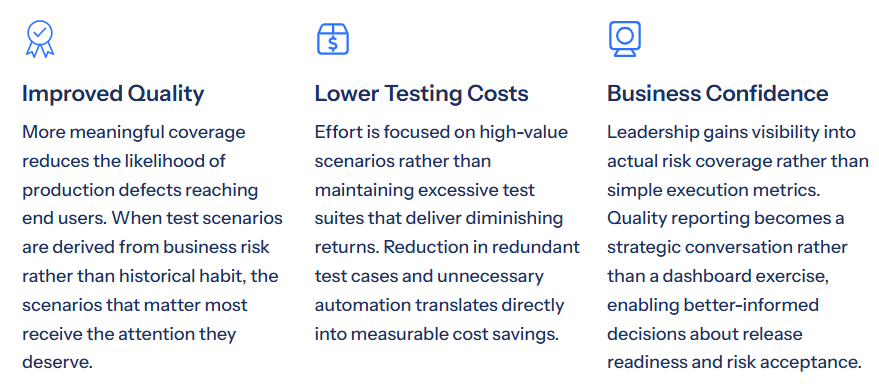
Organisations that combine Contextual AI with disciplined automation frameworks typically achieve measurable benefits across four key dimensions. These benefits are not theoretical they are the practical outcomes of a quality strategy that begins with business understanding rather than tooling selection. Each benefit reinforces the others, creating a compounding improvement in delivery capability that becomes a genuine competitive advantage over time.
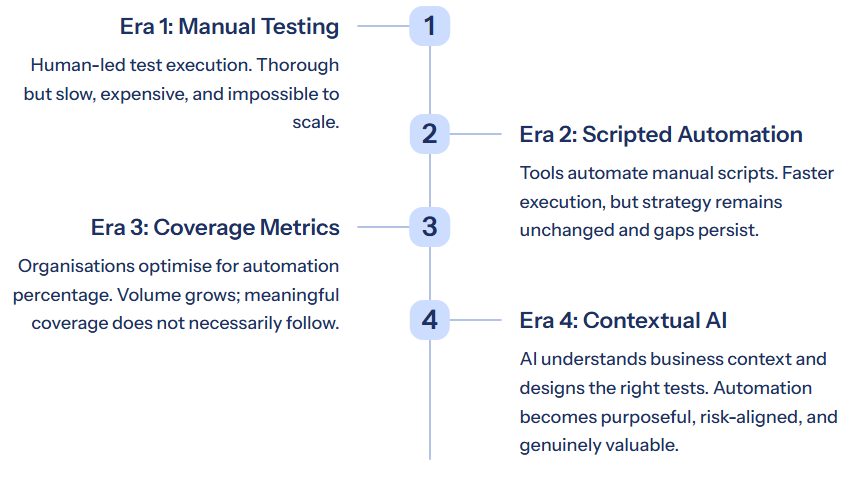
The testing industry is entering a genuinely new phase. For years, organisations focused relentlessly on executing tests faster more automation, more parallelisation, more tooling. These investments delivered real efficiency gains, but they left the underlying question of testing strategy largely unaddressed. Speed of execution means little if the tests being executed do not reflect the risks that actually threaten production stability and business continuity.
The focus is now shifting not away from automation, but toward the intelligent design of what gets automated. The most mature organisations are recognising that quality begins long before a single line of automation code is written. It begins with understanding business outcomes. It begins with identifying risk. It begins with ensuring the right scenarios are covered before asking how quickly they can be executed. Contextual AI makes this possible at a scale that traditional testing approaches cannot achieve through human effort alone.
Automation remains critical. CI/CD pipelines, regression suites, and continuous testing infrastructure are essential components of any modern delivery organisation. But automation is no longer the strategy it is the execution layer of a broader quality engineering capability. Organisations that understand this distinction will build testing programmes that genuinely protect them. Those that do not will continue to invest heavily in automation while wondering why production incidents keep occurring.
At Testpoint, we believe most organisations are not suffering from a lack of automation. They are suffering from a lack of meaningful test coverage. The distinction matters because it determines where investment should be directed, how quality should be measured, and what success genuinely looks like for an enterprise testing programme. More tests have never been the answer. Better tests designed with purpose, grounded in business understanding, and executed with precision are.
Our approach combines business process analysis, requirements validation, risk-based testing, Contextual AI-driven test generation, enterprise test automation, and continuous quality engineering into a coherent and measurable quality strategy. We begin by understanding how your organisation operates its processes, its risks, its regulatory obligations, and its critical business outcomes. Only then do we design the test coverage that genuinely protects those outcomes. And only then do we automate, using the tools that best serve your environment.
The outcome is not simply more tests. It is better quality, faster delivery, lower risk, and measurable business value. Because the future of testing is not about executing more tests. It’s about knowing which tests matter and having the capability, the methodology, and the technology to identify them with confidence