HR and payroll transformation exposes organisations to more than technical delivery risk. Incorrect award interpretations, complex allowances, poor workforce data and unreliable integrations can affect employee pay, compliance obligations and public trust. This guide explains how Australian public-sector agencies can build defensible assurance around business rules, employee scenarios and the complete employee-to-pay process. It examines where manual test design and generic AI-generated cases can miss critical exceptions, how contextual AI may support traceable coverage, and why payroll specialists must approve expected results. It also sets out controls for parallel payroll, reconciliation, cutover and executive release decisions. Use the practical readiness checklist and phased assurance roadmap to identify gaps before they affect employees and to establish accountable governance throughout the transformation.
For organisations managing intricate awards, rostering requirements, and de-centralised workforce structures, the risks are real:
The lessons from programs like Canada’s Phoenix payroll system are a stark reminder: without disciplined oversight, transparent accountability, and genuine readiness assurance, even well-funded transformations can cause lasting harm.
Before selecting test cases, identify the failure modes that could cause incorrect employee payments, delayed pay, non-compliant deductions, inaccurate leave balances or unreliable reporting. Rank these by employee impact, frequency, financial exposure and the difficulty of detecting an error after the payroll run.
A practical risk register should distinguish rule interpretation from configuration defects, integration failures and poor source data. For example, an allowance may be correctly configured for one award classification but fail when an employee changes location, works across cost centres or receives backdated adjustments. These are different failure paths and require different test data and expected results.
Assign a business owner for each critical pay rule and a technical owner for the system or interface that applies it. HR and industrial-relations specialists should approve the rule interpretation; payroll operations should validate the expected payslip and reconciliation; technology teams should demonstrate that configurations and integrations implement those rules correctly. The test manager should maintain the traceability and evidence, not become the owner of the business rule.
For public-sector agencies, this division of responsibility matters when a programme crosses awards, enterprise agreements, entities, agencies and decentralised rostering arrangements. A single sign-off from the technology delivery team is not a substitute for payroll business acceptance.
Traditional testing approaches often rely on subject matter experts (SMEs) to design test cases manually, a process that can become slow and costly when business rules are complex. When enterprise agreements run to hundreds of pages, when rostering rules interact with allowances in complex ways, and when workforce data spans multiple entities, manual test design simply cannot keep pace.
Generic AI tools can introduce further risk if their output is accepted without business-context validation. Without deep business context, AI-generated test cases are based on assumptions and patterns not your actual pay rules, award conditions, or workforce configurations. The result is coverage that looks comprehensive but misses the edge cases that cause underpayments and compliance failures.
Start with a catalogue of employee and employment variations, then combine those dimensions with the pay events that create the greatest exposure. Useful dimensions include award or enterprise agreement, classification, ordinary hours, overtime, shift penalties, allowances, leave type, part-time arrangements, effective dates, backpay and employment changes. The objective is not to test every mathematical combination but to choose representative, boundary and high-risk combinations with a documented rationale.
For each selected scenario, record the source clause or approved rule, employee and roster inputs, expected gross and net components where applicable, calculation evidence, system outputs and approval owner. Include negative cases, such as an invalid classification or missing effective date, to verify that the process rejects or flags incorrect inputs rather than silently producing a payment.
Link each critical industrial instrument or pay-policy rule to one or more test scenarios, the relevant system configuration, the executed result and any open defect. A rule without an approved expected outcome should be flagged as a business interpretation issue, not treated as a passed test. This makes unresolved coverage visible to the programme steering committee before go-live.
For high-risk payroll scenarios, calculate the expected outcome independently from the system being tested. An approved reference calculation should identify the applicable instrument, classification, pay period, base rate, overtime or penalty multipliers, allowance conditions, leave treatment and any effective-dated changes. Retain the calculation steps so that a failed test can be investigated without repeating the entire interpretation exercise.
Separate policy questions from software defects. If two payroll specialists interpret a clause differently, resolve that ambiguity through the designated industrial-relations or policy owner before changing the application. Record the decision and update the expected-result catalogue. This prevents a test from passing merely because its expected value was copied from the system’s own calculation.
Test the boundaries at which pay rules change: shifts crossing midnight, public holidays, overtime thresholds, minimum engagement periods, employee classification changes and effective dates. Include interactions between allowances, penalties, leave and roster amendments. These combinations often create more risk than straightforward ordinary-hours calculations.
Retrospective changes deserve a dedicated set of scenarios. Validate backpay, corrected timesheets, reversed leave, late approvals and adjustments spanning multiple pay periods. Check both the employee-facing outcome and downstream accounting entries. Record which combinations are tested directly and which are covered through approved equivalence classes, so coverage claims remain transparent.
Testpoint’s Contextual AI solution was built specifically for this challenge. Rather than generating tests from generic prompts, it reads and understands your actual business rules enterprise agreements, pay policies, rostering configurations, and workforce data before producing a single test case.
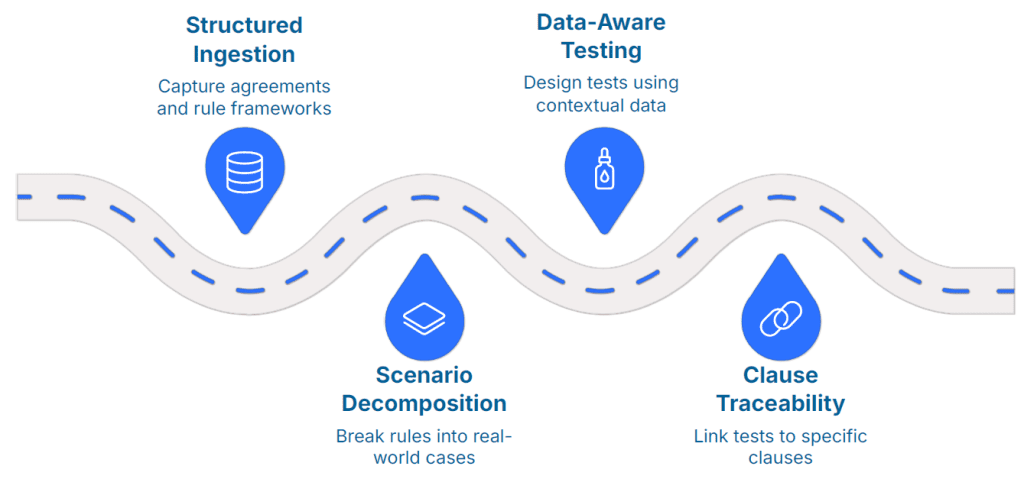
Contextual AI ingests your actual industrial instruments, allowance schedules, and pay rules. Test cases are generated from your real operational logic not assumptions. This provides an opportunity to detect award-interpretation issues before go-live, provided the source rules and generated scenarios are validated by payroll specialists.
AI-assisted drafting may reduce repetitive scenario preparation, although the time saved depends on source quality, complexity, review effort and the technology used. Every generated test case is traceable back to the specific requirement, rule, or policy it covers supporting a more defensible audit trail when the underlying rules, approvals, execution evidence and exceptions are retained.
Contextual AI doesn’t just create tests it identifies gaps in coverage. You get clear visibility into what’s tested, what’s not, and where risk remains. For agencies with complex rostering and multi-award environments, this helps teams identify unresolved risks before a release decision.
Instead of consuming months of your most experienced people’s time on test design, Contextual AI shifts their role to validation. SMEs review and approve high-quality, pre-generated scenarios allowing their time to focus on validating complex pay interpretations, exceptions and high-risk outcomes.
Contextual AI can accelerate drafting when it receives reliable business inputs, but it cannot independently establish that a legal or industrial interpretation is correct. Payroll specialists must review generated scenarios against current agreements, policy versions, applicable effective dates and approved examples. Retain the source reference and reviewer decision for each accepted scenario.
Apply controls for sensitive employee information: minimise personally identifiable data, use masked or synthetic employee records where practical, restrict access to source documents and record how AI-generated artefacts are reviewed and retained. A generated test is not evidence of compliance until it has an approved expected result and a valid execution outcome.
Track scenario-design effort, SME review effort, high-risk rule coverage, defect detection, escaped payroll errors, rework and reconciliation exceptions. Compare results with the same measures from a defined baseline. Report both efficiency and assurance outcomes; a faster design process is not sufficient if expected results are incorrect or important exceptions remain untested.
The original article reports the following outcomes from HRIS, payroll and ERP transformation work. These figures are presented as Testpoint-reported examples rather than independently verified benchmarks; confirm the underlying case evidence before using them as externally substantiated claims:
These reported outcomes are associated with combining Contextual AI with disciplined enterprise governance, phased readiness assessment, and structured engagement and should be assessed against each programme’s own baseline and governance controls.
Payroll accuracy depends on more than the calculation engine. Verify the complete flow from employee master data and position changes through rostering, time and attendance, approvals, payroll calculation, general ledger posting, banking outputs and employee-facing payslips. Reconcile record counts, key totals and exception queues at each interface, including rejected or delayed transactions.
Include changes that occur close to payroll cut-off: new starters, terminations, transfers, retrospective adjustments, leave reversals and off-cycle payments. For each integration, identify who monitors failures, how items are reprocessed and how duplicate or missing payments are prevented.
Where feasible, compare new-system calculations with an independently reviewed expected-pay baseline or a controlled legacy payroll run. Differences must be classified rather than simply counted: an approved policy change is different from a defect, a data issue or a legacy-system error. Reconcile by employee, pay element, payroll group and financial totals, and document materiality thresholds before testing begins.
Establish exit criteria covering critical rule coverage, unresolved high-severity defects, material reconciliation variances, interface reliability, security and access controls, operational workarounds and payroll-team readiness. A go-live decision should identify residual risks, accountable approvers and a plan to protect employees if an issue is discovered after cutover.
As you plan or progress your HR and pay transformation, the testing approach you choose will determine whether your program delivers safely or creates new risks. Ask your testing partner:
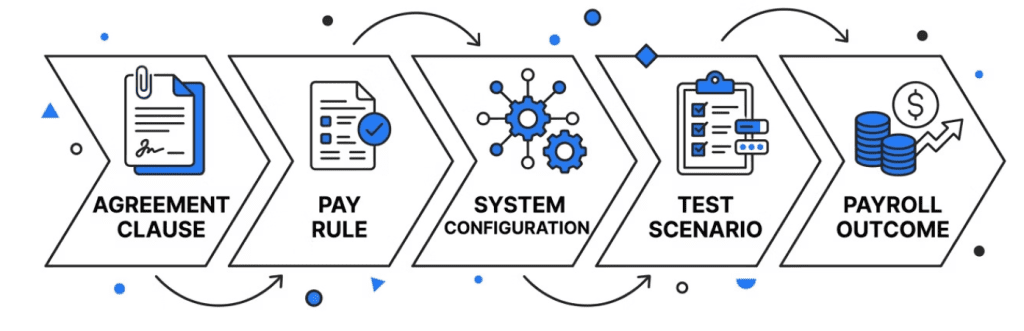
A negative answer should prompt a documented gap assessment, compensating controls and a decision about whether the residual payroll risk is acceptable.
Migration assurance should cover employee identifiers, organisational assignments, bank details, tax and superannuation attributes, leave balances, employment history, pay rates and effective-dated records. Compare record counts and financial control totals before and after migration, then sample individual employees across high-risk cohorts. Record exceptions and whether they are accepted, corrected or subject to a compensating control.
For payroll reconciliation, reconcile the same pay period across source time records, payroll results, payslips, payment files and finance postings. Analyse variances by employee and pay element rather than relying only on a balanced grand total. Two incorrect employee payments can cancel each other out at the aggregate level while still creating serious employee harm.
Go-live readiness includes the people and processes that will operate the system. Payroll administrators need documented exception procedures, role-based access, reconciliations, escalation contacts and authority to halt or correct a pay run. Confirm that the service desk can recognise payroll-critical incidents and that urgent employee payment issues have a clear path to resolution.
During hypercare, monitor failed interfaces, manual adjustments, reconciliation breaks, payment rejections and employee enquiries. Review incident trends after each pay cycle and feed newly discovered scenarios into regression coverage. Define the conditions for leaving hypercare based on stable operations and accountable acceptance, not simply elapsed time since deployment.
Use this checklist during readiness reviews and record the evidence owner and status for each control.
Discovery and design: inventory industrial instruments, map critical employee journeys, resolve ambiguous rules and identify the most consequential payroll risks.
System and integration testing: validate configured calculations, exception handling, interfaces, security roles and reconciliation controls using representative data.
Business acceptance and parallel pay: have payroll and HR owners approve expected results, investigate material variances and demonstrate operational readiness.
Cutover and hypercare: rehearse final data loads and payroll cut-offs, monitor the first pay cycles, establish rapid incident triage and retain a controlled process for correcting employee impacts.
This phased approach gives decision-makers explicit evidence at each gate and prevents a successful technical deployment from being mistaken for payroll readiness.
Testpoint’s Contextual AI is purpose-built for the complexity of Australian public sector HR and pay transformation.
The approach combines Vansah technology, governance frameworks and specialist testing expertise to support traceable test readiness and evidence-led release decisions.
For further information, get in touch to discuss the programme context, scope and assurance requirements.
Discuss your workforce complexity, pay rules, integration risks and release timeline with Testpoint’s HR and payroll testing specialists.