Imaging, Printing & Technology Solutions
Testpoint introduced its ground breaking Contextual AI-led testing engagement model.
Rather than increasing resources or compressing scope, Testpoint scaled intelligence.
The Contextual AI platform:
Compliance and governance were embedded from inception not added later.
Testing shifted from manual interpretation to intelligence-driven execution readiness.
While reducing test design effort was a significant outcome, Testpoint’s broader objective was to improve the organisation’s overall testing maturity and establish a sustainable quality engineering capability.
Traditional testing within the program was largely document-driven, heavily dependent on SME knowledge, and lacked the consistency required to support scalable automation. Through the adoption of Contextual AI, Testpoint transformed testing from a manual activity into a structured, traceable, and repeatable quality process.
Using Vansah’s Contextual AI capability, Testpoint analysed business requirements, process flows, integrations, and business rules to generate high-quality test scenarios aligned to real operational workflows. This enabled:
Rather than simply generating more test cases, the focus was on generating the right test cases—ensuring business-critical paths, exception scenarios, integrations, and compliance requirements were comprehensively covered.
To validate the long-term value of the approach, Testpoint also conducted an automation proof of concept (POC) using the Contextual AI-generated test assets.
Because the test cases were created using structured business logic and consistent coverage models, they were inherently automation-ready. Testpoint selected representative high-value business scenarios and successfully demonstrated how the AI-generated assets could be converted into automated regression tests with minimal rework.
The POC confirmed that:
This provided the client with a clear roadmap for future automation adoption while ensuring that immediate delivery objectives were achieved.
The result was not only a faster testing cycle but a more mature, sustainable quality engineering capability capable of supporting ongoing ERP transformation and future releases.
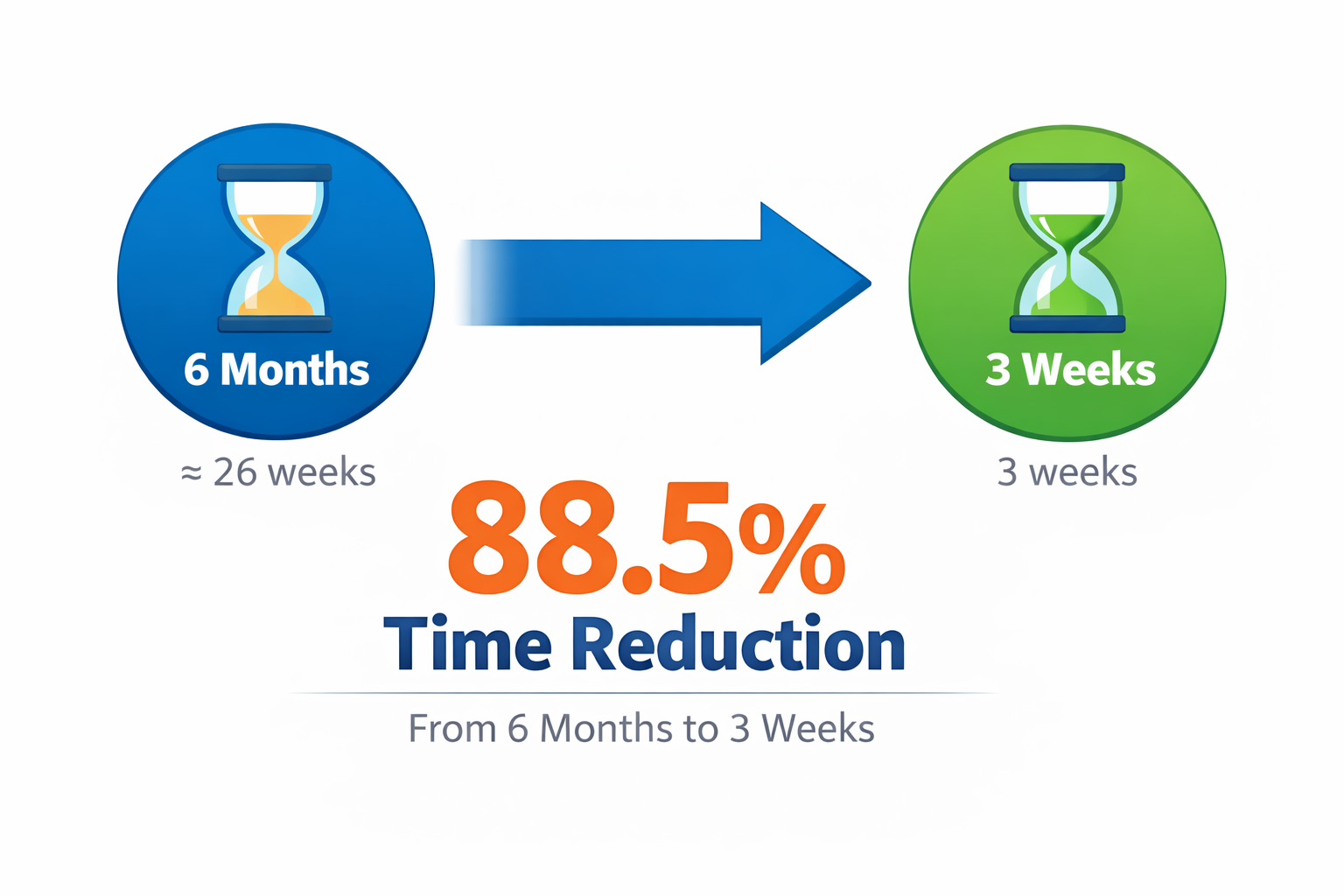
Manual test design effort was reduced from an estimated six months to just three weeks, including setup, workshops, refinement, and approval cycles.

The program moved into System Integration Testing and User Acceptance Testing significantly earlier than planned, without compromising coverage.
Business stakeholders validated structured AI-generated outputs instead of designing scenarios from scratch dramatically lowering time demands.
Regulatory requirements, segregation-of-duties controls, workflow validations, and statutory tax processing were embedded directly into structured test logic.
Master data, balances, and reconciliation processes were formally validated within generated test scenarios, reducing post-go-live exposure.
Traceability from requirement to configuration to test case improved transparency, audit readiness, and stakeholder assurance.
By automating and structuring test design through Contextual AI, the organisation:
Quality assurance evolved from a schedule constraint into a strategic enabler of digital transformation.
For complex ERP modernisation programs, the greatest risk is not technology failure it is inadequate validation at scale. Through the adoption of Contextual AI, this global imaging provider fundamentally redefined its testing model.
What once required six months of manual effort was delivered in three weeks with broader coverage, stronger governance, and higher executive confidence.
Testing became not just faster but smarter.
Speak to Testpoint about scaling testing with intelligence, not headcount.