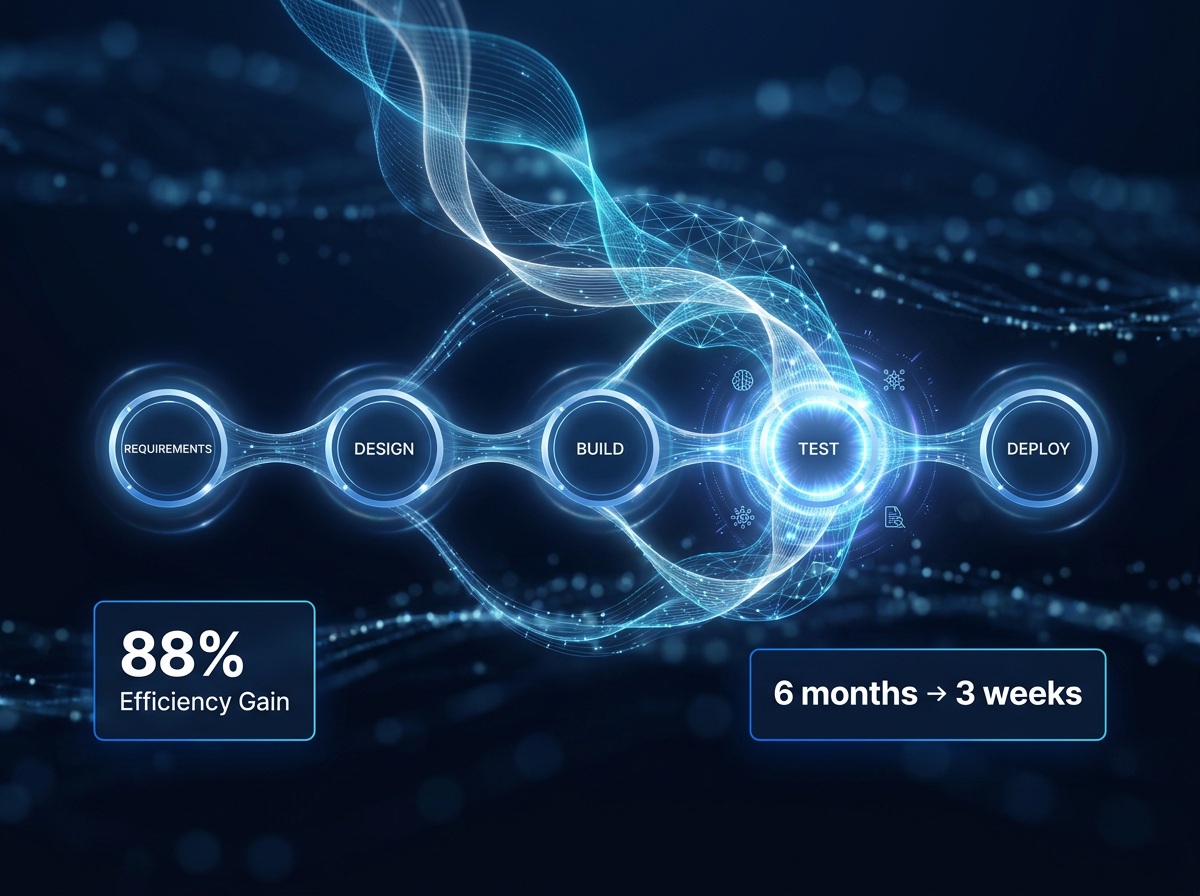
Enterprise leaders have spent the last several years asking the same question:
How will AI change software delivery? The question itself is becoming outdated.
The organisations achieving the greatest gains today are no longer exploring AI. They are operationalising it across the Software Development Lifecycle (SDLC) and the Testing Lifecycle to improve delivery speed, reduce effort, increase quality, and strengthen governance.
AI is already augmenting delivery teams in ways that were previously impossible. These are not pilots or experimental proofs of concept. These are production programs delivering measurable outcomes using commercial technology deployed in complex enterprise environments.
The conversation is no longer about whether AI will impact software delivery. The conversation is about how quickly organisations can benefit from it.
Traditional software delivery models were built around one fundamental constraint:
Human capacity.
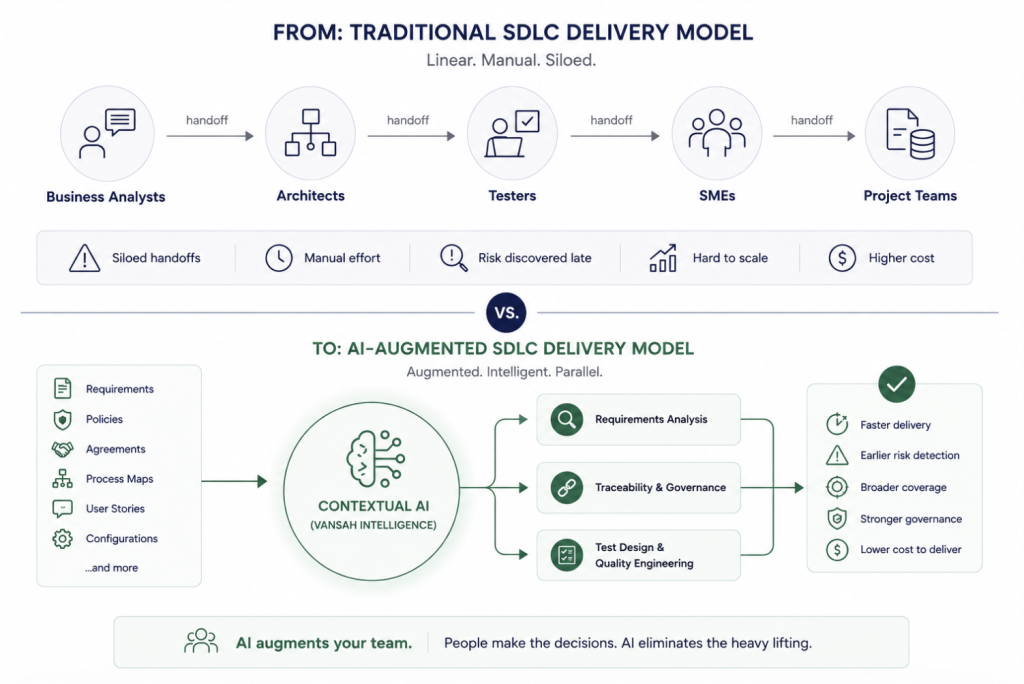
Business analysts interpreted requirements. Architects translated requirements into designs. Testers converted requirements into test scenarios. SMEs reviewed outputs. Project teams manually maintained traceability.
Every stage relied heavily on people performing labour-intensive activities that scaled linearly with complexity.
As systems became more integrated, regulations became more demanding, and delivery timelines became shorter, this model became increasingly difficult to sustain.
Most organisations today face the same challenges:
AI changes this equation.
Rather than replacing delivery teams, AI augments them by automating the effort-intensive activities that consume the majority of delivery capacity.
The result is a fundamentally different operating model.
The most valuable application of AI is not writing code. The greatest value is being realised much earlier in the lifecycle.
Modern contextual AI platforms can ingest business requirements, policies, operating procedures, industrial agreements, process maps, user stories, configuration documents, and solution designs and convert them into structured delivery artefacts.
This allows organisations to accelerate activities that have historically required substantial manual effort.
One of the largest sources of project risk is incomplete or misunderstood requirements.
AI can analyse large volumes of documentation and identify:
Instead of relying solely on manual review workshops, delivery teams can use AI to rapidly surface risks and inconsistencies before design and testing begin.
This improves quality at the earliest possible stage of the lifecycle.
Maintaining traceability has traditionally been one of the most resource-intensive activities within large programs.
For regulated industries including healthcare, government, financial services, and aged care, this capability significantly improves audit readiness and compliance assurance.
This is where Testpoint has seen some of the most significant gains.
Using Contextual AI through Vansah Intelligence, organisations can generate structured test scenarios directly from business rules rather than manually creating them from documentation.
The distinction is important. Generic AI reads documents.
Contextual AI understands the underlying logic that governs business processes.
It can interpret:
The result is faster test generation, broader coverage, stronger traceability, and earlier identification of risk.
Most importantly, it allows SMEs to validate outputs rather than create them from scratch.
What we are seeing today is not simply an improvement in testing.
It is the emergence of a new delivery model.
AI is enabling organisations to:
The most successful organisations are not replacing their analysts, testers, architects, or SMEs.
They are enabling those experts to focus on judgement, validation, decision-making, and business outcomes while AI handles the repetitive activities that consume valuable delivery capacity.
This creates a multiplier effect across the entire SDLC.
The market is moving beyond experimentation.
AI is already delivering measurable improvements in productivity, quality, governance, and speed.
The organisations benefiting most are not waiting for the technology to mature. They are deploying it today.
At Testpoint, we are helping organisations apply AI where it creates the greatest value, across the full software delivery lifecycle, from requirements analysis through to testing, assurance, and production readiness.
Because the future of software delivery is not AI replacing people.
It is AI amplifying what great delivery teams can achieve.