Australia’s public sector is at an inflection point. With growing scrutiny around payroll integrity, complex award and enterprise agreement obligations, and the lessons of high-profile transformation failures still fresh, agencies can no longer afford to treat HR and pay system upgrades as purely technical exercises.
Transformation is a governance, workforce, and risk management challenge and testing is the discipline that holds it all together.
The Stakes Have Never Been Higher
For organisations managing intricate awards, rostering requirements, and de-centralised workforce structures, the risks are real:
The lessons from programs like Canada’s Phoenix payroll system are a stark reminder: without disciplined oversight, transparent accountability, and genuine readiness assurance, even well-funded transformations can cause lasting harm.
What Most Testing Approaches Get Wrong
Traditional testing approaches rely on subject matter experts (SMEs) manually designing test cases a slow, expensive, and error-prone process. When enterprise agreements run to hundreds of pages, when rostering rules interact with allowances in complex ways, and when workforce data spans multiple entities, manual test design simply cannot keep pace.
Generic AI tools make this worse, not better. Without deep business context, AI-generated test cases are based on assumptions and patterns not your actual pay rules, award conditions, or workforce configurations. The result is coverage that looks comprehensive but misses the edge cases that cause underpayments and compliance failures.
A Different Approach: Contextual AI for HR & Pay Testing
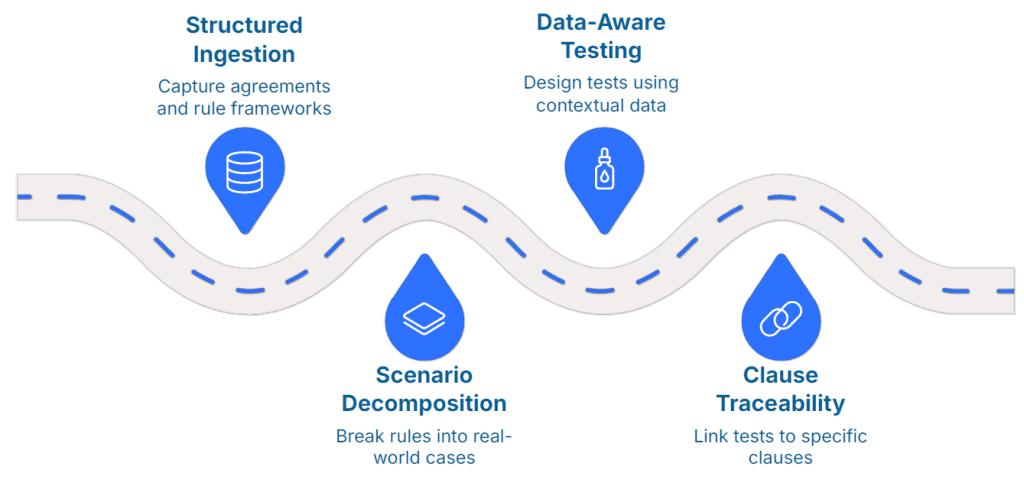
Testpoint’s Contextual AI solution was built specifically for this challenge. Rather than generating tests from generic prompts, it reads and understands your actual business rules enterprise agreements, pay policies, rostering configurations, and workforce data before producing a single test case.
Here’s what that means in practice:
1. Reads Your Enterprise Agreements and Pay Policies
Contextual AI ingests your actual industrial instruments, allowance schedules, and pay rules. Test cases are generated from your real operational logic not assumptions. This means award interpretation errors are caught before go-live, not after the first pay run.
2. Generates Accurate, Traceable Test Coverage at Scale
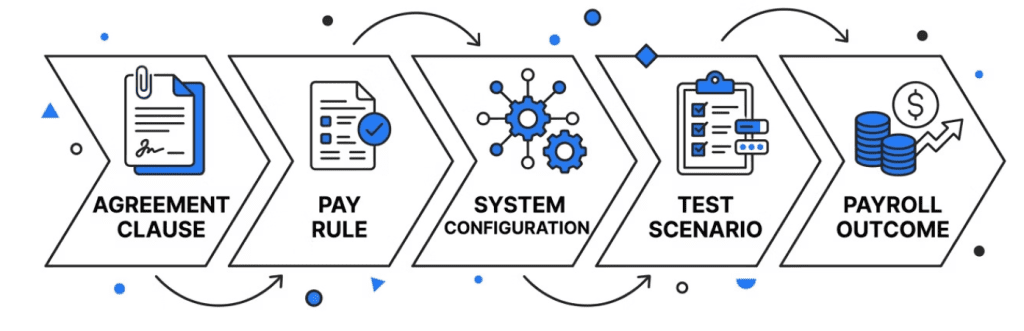
What previously took months of SME workshops and manual design can now be achieved in days. Every generated test case is traceable back to the specific requirement, rule, or policy it covers giving you defensible, audit-ready assurance that executives and regulators can rely on.
3. Eliminates Blind Spots Before They Become Payroll Errors
Contextual AI doesn’t just create tests it identifies gaps in coverage. You get clear visibility into what’s tested, what’s not, and where risk remains. For agencies with complex rostering and multi-award environments, this is the difference between a successful go-live and a payroll disaster.
4. Reduces SME Dependency Without Reducing Quality
Instead of consuming months of your most experienced people’s time on test design, Contextual AI shifts their role to validation. SMEs review and approve high-quality, pre-generated scenarios dramatically reducing fatigue and protecting their capacity for the work only they can do.
Proven Results in HR & Pay Transformation
Testpoint has applied this approach in complex HRIS and payroll transformation programs with measurable outcomes:
These aren’t theoretical gains. They are the result of combining Contextual AI with disciplined enterprise governance, phased readiness assessment, and structured engagement the same disciplines that distinguish successful transformation programs from those that make headlines for the wrong reasons.
What Australian Agencies Should Demand from Testing
As you plan or progress your HR and pay transformation, the testing approach you choose will determine whether your program delivers safely or creates new risks. Ask your testing partner:
If the answer to any of these is no, your payroll integrity is at risk.
Ready to Transform with Confidence?
Testpoint’s Contextual AI is purpose-built for the complexity of Australian public sector HR and pay transformation.
We combine Vansah Enterprise technology, governance frameworks, and specialist expertise to deliver test readiness that is fast, accurate, and defensible.